
The MANSORY Rolls-Royce Phantom Powered by Ultra HD Film
Stay updated with the latest smart glass technology, PDLC smart film applications, privacy glass innovations, and luxury architectural solutions.
- Home
- The MANSORY Rolls-Royce Phantom Powered by Ultra HD Film
- Posted October 5, 2026
- By Admin
When Privacy Becomes Part of the Luxury: The MANSORY Rolls-Royce Phantom Powered by Ultra HD Film
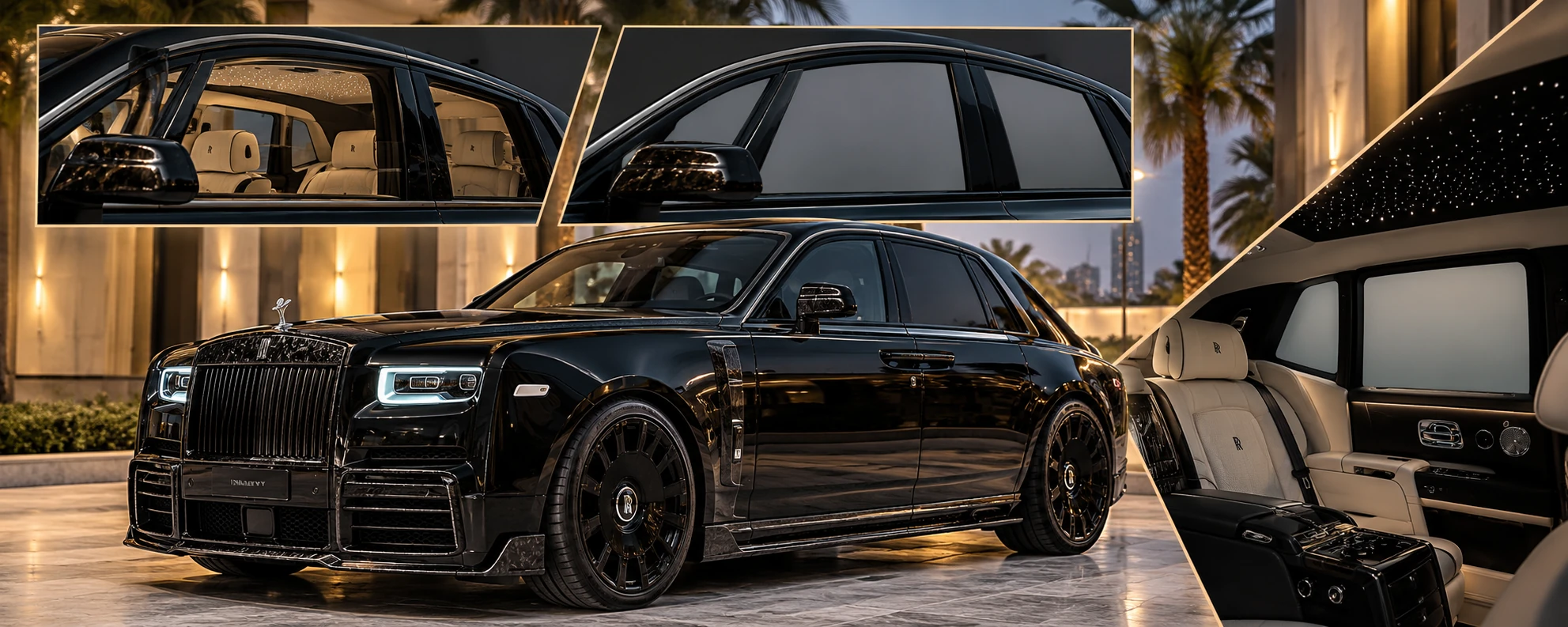
Luxury is no longer defined only by what a vehicle looks like. The modern luxury experience is also about what the vehicle can do—how it responds to its occupants, how discreetly technology is integrated, and how effortlessly it adapts to different moments.
That philosophy is at the heart of this custom MANSORY Rolls-Royce Phantom, where HD Smart Glass brings its Ultra HD Film technology into the world of bespoke automotive design.
Instead of treating privacy as an accessory added to the vehicle, this project approaches privacy as part of the interior experience itself. The result is a sophisticated combination of automotive design, intelligent glass technology, and on-demand privacy.
From Luxury Interior to Private Environment
A premium vehicle can be many things at once. It can be a means of transportation, a mobile office, a place to relax, or a private space between destinations.
For passengers in chauffeur-driven and VIP vehicles, the ability to create privacy can be just as important as comfort, materials, or entertainment.
Traditional solutions often rely on curtains, fixed shades, or permanently darkened glass. They can provide privacy, but they also introduce a physical element into an interior that has otherwise been carefully designed around simplicity and refinement.
Ultra HD Film takes a different approach. It turns selected vehicle glass into a controllable privacy surface, allowing the character of the glass to change according to the passenger’s needs.
Ultra HD Film: Privacy That Responds to the Moment
Ultra HD Film by HD Smart Glass is a switchable privacy film solution designed to provide controlled privacy through electronically activated smart-film technology.
When transparency is preferred, the glass maintains a clear appearance. When privacy is required, the system can be switched to its privacy state, creating a more secluded environment for the occupants.
The important difference is not simply that the glass becomes private. It is that privacy becomes controllable.
A passenger can enjoy an open view of the surroundings one moment and create a more private cabin environment the next—without reaching for a curtain or manually adjusting a blind.
Why Smart Privacy Belongs in a Bespoke Rolls-Royce
The interior of a Rolls-Royce is designed around an idea of quiet luxury. Materials, lighting, seating, surfaces, and technology are expected to work together rather than compete for attention.
That makes automotive privacy particularly interesting. The solution has to provide a practical benefit while respecting the visual language of the vehicle.
In the MANSORY Rolls-Royce Phantom, Ultra HD Film introduces an intelligent privacy function without turning the cabin into a collection of visible accessories.
It is technology designed to become part of the experience rather than technology designed to announce itself.
The Difference Between Tinted Glass and Switchable Privacy
Automotive window tint and switchable smart film solve different problems.
Tint provides a predetermined visual effect. Once the glass is tinted, that level of shading remains essentially constant. Switchable smart film introduces another dimension: choice.
- Tinted glass: Provides a relatively fixed level of shading and privacy.
- Switchable film: Allows the privacy state of the glass to be changed electronically.
- Traditional curtain: Provides physical privacy but remains visible inside the cabin.
- Smart privacy: Integrates the privacy function directly into the glass experience.
For a bespoke luxury vehicle, that distinction matters. The objective is not simply to make the windows darker. It is to create a more intelligent relationship between the passenger and the surrounding environment.
How PDLC Smart Film Creates Controllable Privacy
Ultra HD Film technology is based on the principles of PDLC (Polymer Dispersed Liquid Crystal) smart-film technology.
Inside the film is a layer containing liquid crystal particles. Electrical control changes their alignment, altering how light interacts with the film.
This creates two distinct visual states:
- Transparent State: The film allows a clearer view through the glass.
- Privacy State: The film scatters incoming light to create a privacy effect.
The technology is simple in principle, but its impact on a luxury interior is significant: the glass becomes an active part of the passenger environment.
More Than a Car Window
In a conventional vehicle, a window is primarily a functional component. It provides visibility, light, and separation from the outside environment.
With smart-film technology, that same surface can become part of the vehicle’s intelligent interior.
The glass can respond to changing requirements—open when the passenger wants visibility and private when discretion becomes more important.
This shift from static glass to responsive glass is what makes smart-film technology particularly relevant to the next generation of luxury mobility.
Designed for the VIP Passenger Experience
For VIP and executive transportation, privacy is not simply about blocking visibility. It is about creating an environment where passengers feel comfortable conducting their journey on their own terms.
Private Conversations
A more secluded cabin can provide an appropriate environment for private conversations and personal calls while travelling.
Executive Travel
For business professionals, the rear cabin can become a more discreet space between meetings and destinations.
Chauffeur-Driven Luxury
Passengers can control their preferred level of privacy without relying on manually operated curtains.
Personal Comfort
The ability to change the glass state gives passengers greater control over their immediate environment.
Where Automotive Smart Film Fits Beyond the Rolls-Royce
The MANSORY Rolls-Royce Phantom demonstrates one high-end application, but the underlying idea extends to a broader category of premium mobility.
- VIP and executive vehicles
- Luxury SUVs
- Chauffeur-driven cars
- Premium limousines
- Custom-built vehicles
- Private transportation
- Special-purpose luxury interiors
For each application, the right configuration depends on the vehicle, glass construction, desired privacy effect, installation requirements, and overall interior design.
Smart Privacy Is Becoming a Luxury Design Element
The most interesting development in luxury design is not the addition of more technology. It is the ability to make technology feel almost invisible.
Smart lighting disappears into architecture. Automated climate systems operate without demanding attention. Hidden entertainment systems appear only when needed.
Smart privacy follows the same principle.
The technology remains discreet until the passenger needs it. At that moment, the glass itself becomes the interface.
That is why switchable privacy is particularly compelling in high-end environments: the luxury is not in seeing the technology. The luxury is in experiencing what it enables.
Beyond Automotive: The Same Philosophy Across Spaces
The philosophy behind Ultra HD Film is not limited to vehicles. The same idea—turning ordinary glass into a responsive privacy surface—can be applied across modern architecture.
Luxury Residences
Large glass facades, bathrooms, bedrooms, and private spaces can benefit from controllable privacy without relying exclusively on curtains or blinds.
Executive Offices
Meeting rooms and boardrooms can transition between open and private environments while maintaining a clean architectural appearance.
Hotels & Hospitality
Smart privacy can become part of the guest experience in premium suites, bathrooms, and exclusive hospitality environments.
Healthcare
Switchable privacy solutions can provide flexible visual separation in selected medical and clinical environments.
Why HD Smart Glass
HD Smart Glass approaches smart film as more than a commodity film product. Every project begins with understanding the glass, the environment, the intended experience, and the role privacy needs to play within the space.
From bespoke automotive applications to architectural installations, our focus is on creating smart privacy solutions that feel integrated rather than added on.
Our project approach includes:
- Application-specific smart film consultation
- Project and glass assessment
- Custom privacy solutions
- Professional installation
- Integration with suitable control systems
- Residential, commercial, hospitality, and automotive applications
- Support for projects across the UAE and GCC
The MANSORY Rolls-Royce Phantom: A Statement in Intelligent Luxury
This project represents more than the installation of privacy film on a luxury vehicle.
It demonstrates a different way of thinking about automotive interiors—where privacy does not need to be a curtain, a fixed shade, or a permanent visual barrier.
With Ultra HD Film by HD Smart Glass, the vehicle’s glass becomes an adaptable element of the passenger experience.
Clear when openness is preferred. Private when discretion matters. Integrated when luxury demands that technology remain beautifully understated.
This is where luxury meets intelligent privacy.
Frequently Asked Questions
What is automotive smart film?
Automotive smart film is a switchable film solution designed for selected vehicle glass applications. It allows the glass to transition between different optical states using electrical control.
What is Ultra HD Film?
Ultra HD Film by HD Smart Glass is a smart privacy film solution developed for applications where controllable privacy and a refined finish are required.
How is smart film different from window tint?
Traditional window tint provides a relatively fixed visual effect. Switchable smart film is designed to provide a controllable privacy function, allowing the glass to change between transparent and privacy states.
Can smart film be used in a Rolls-Royce?
Smart film can be considered for selected luxury automotive applications. Suitability depends on the vehicle, glass configuration, installation requirements, and the intended application.
Who is automotive privacy film suitable for?
Automotive privacy solutions can be particularly relevant to VIP passengers, executives, chauffeur-driven vehicles, luxury car owners, and bespoke automotive projects.
Does smart film replace curtains in luxury vehicles?
Smart film can provide an alternative approach to traditional privacy curtains by integrating the privacy function directly into the glass. The appropriate solution depends on the vehicle and the customer’s requirements.
What is PDLC technology?
PDLC stands for Polymer Dispersed Liquid Crystal. It is a technology used in switchable privacy film and smart glass to control the optical state of a glass surface through electrical activation.
Experience the Future of Automotive Privacy
The future of luxury mobility will not simply be about adding more features. It will be about creating environments that respond intelligently to the people inside them.
The MANSORY Rolls-Royce Phantom powered by Ultra HD Film is one example of that future—where bespoke automotive design meets intelligent privacy technology.
Whether your requirement is for a VIP vehicle, executive car, luxury SUV, bespoke interior, or architectural project, HD Smart Glass can help explore the possibilities of switchable privacy technology.
No more curtains. No more shutters. Welcome to HD.
Bring Intelligent Privacy to Your Next Project
Looking for automotive smart film, switchable privacy film, smart glass, or bespoke privacy solutions? Speak with HD Smart Glass about your project requirements.
Discover Ultra HD Film by HD Smart Glass. Contact Us Today